Metal vs Nylon PG Cable Glands: The Complete PG7, PG9 & PG11 Selection Guide
Sep 21, 2026
Executive Summary
PG7, PG9 and PG11 are universal standard cable gland sizes available in both metal and nylon constructions. Selecting the right material is just as critical as choosing the correct PG size for reliable long-term performance. This guide breaks down performance differences, ideal use cases and cost tradeoffs across each standard PG size, helping engineering and procurement teams match material and sizing to operating conditions and achieve the best balance of cost and reliability.
Table 1: Key performance comparison between nylon and metal PG glands
Performance Parameter
Nylon PG Glands
Metal PG Glands
Upfront Cost
Low
Higher
Operating Temperature Range
Limited tolerance
Wide range
Vibration Resistance
Poor (tends to loosen)
Excellent
Impact & UV Resistance
Poor
High
EMI/RFI Shielding
Not inherent
Inherent
Service Life in Demanding Environments
Shorter
Significantly longer
1. Core Performance Differences: Metal vs Nylon PG Cable Glands
Before comparing by size, understanding the inherent material advantages sets the framework for correct specification:
Nylon PG Glands
Low cost
Natural electrical insulation
Tool-free hand installation
Good resistance to mild alkalis
Limited temperature tolerance; poor UV and impact resistance
Metal PG Glands
High mechanical strength
Wide temperature range
Vibration resistance
Inherent EMI shielding
Significantly longer service life in demanding environments
2. PG7 Cable Glands: Material Comparison & Use Cases
At the PG7 size class, nylon and metal glands share identical thread and cable dimensions, but serve fundamentally different application profiles.
2.1 Nylon PG7 Glands
Nylon PG7 glands are the most cost-effective choice for dry, static indoor applications:
Typical uses: office building wiring, commercial control panels, light industrial assembly lines
Key benefits: natural electrical insulation, quick hand installation, good chemical resistance to mild alkalis
Limitations: maximum continuous operating temperature of 85°C, becomes brittle with long-term UV exposure, poor vibration retention
2.2 Metal PG7 Glands
Metal PG7 glands excel in more demanding operating conditions:
Typical uses: automated production lines, food industry washdown zones, equipment with constant vibration
Key benefits: higher temperature tolerance, mechanical impact resistance, built-in electromagnetic shielding for sensitive analog signal cables
Advantage over nylon: maintains clamping force far longer under constant vibration; stainless steel variants deliver hygiene and ingress performance nylon cannot match
Figure 1: PG7 metal cable gland – construction and finish detail
3. PG9 Cable Glands: Material Comparison & Use Cases
PG9 is the most widely used cable gland size, and the material choice divides most sharply between indoor/static and outdoor/dynamic applications.
3.1 Nylon PG9 Glands
Nylon PG9 glands deliver excellent value for stable, low-stress indoor environments:
Typical uses: indoor electrical distribution cabinets, building wiring systems, dry control rooms
Key benefits: lightweight, non-corrosive, compatible with most standard cable types
Best suited for: environments with stable temperatures and low mechanical stress
3.2 Metal PG9 Glands
Metal PG9 glands are the correct specification for any demanding application:
Typical uses: factory motor control centres, pump skids, conveyor systems, outdoor equipment
Key benefits: vibration resistance, mechanical strength, stable sealing across wide temperature swings
Technical advantage: metal has a much lower thermal expansion coefficient than nylon, so seal compression remains consistent through temperature cycles. Metal PG9 glands also inherently meet higher flame-retardant safety standards than standard nylon alternatives.
Figure 2: PG9 metal cable gland – multi-thread and hex nut construction
4. PG11 Cable Glands: Material Comparison & Use Cases
At the larger PG11 size, metal glands dominate heavy-duty applications, while nylon has very limited suitability.
4.1 Nylon PG11 Glands
Nylon PG11 glands are only appropriate for large-diameter indoor cables in stable, low-stress environments:
Typical uses: main distribution boards in dry commercial buildings
Limitations: lower mechanical strength makes them unsuitable for heavy power cables that experience pulling forces or vibration
4.2 Metal PG11 Glands
Metal PG11 glands are the industry standard for heavy industrial and outdoor power applications:
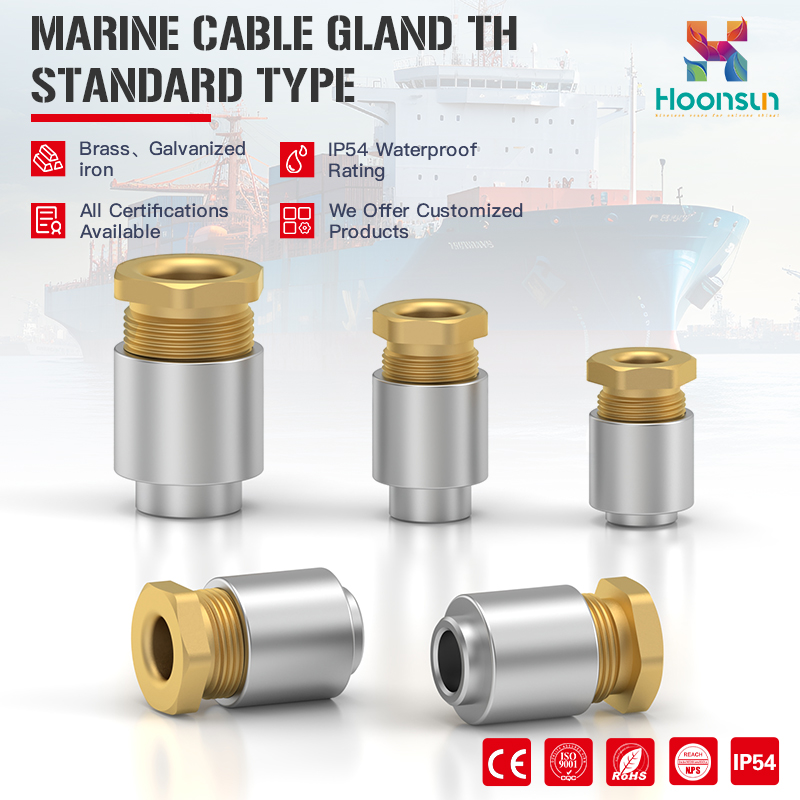
Typical uses: motor feeders, outdoor charging infrastructure, solar combiner boxes, pump stations, coastal and offshore installations
Premium option: 316 stainless steel PG11 glands deliver corrosion resistance that no nylon version can match for marine and salt spray environments
Lifecycle value: the higher upfront cost is quickly offset by much longer service life and reduced maintenance in demanding environments
Figure 3: PG11 metal cable gland – heavy-duty industrial design
5. Optimal Selection Strategy for Mixed Projects
The most cost-effective and reliable approach is to combine both materials across a project, rather than standardizing on a single material:
Use nylon PG7 and PG9 glands for indoor, static, low-stress circuits to control procurement cost
Specify metal glands for all outdoor, high-vibration, high-temperature and shielded cable applications, regardless of PG size
Match metal grade to environmental severity: nickel-plated brass for general industrial use; 316 stainless steel for corrosive, washdown and marine environments
This mixed-material strategy maximizes overall system reliability while keeping total procurement cost reasonable.
6. Frequently Asked Questions
Q: Can I replace a nylon PG9 gland with a metal PG9 gland in an existing panel?
A: Yes. PG size dimensions are standardized regardless of material, so a metal PG9 gland will directly replace a nylon PG9 gland in the same panel hole, with improved mechanical and sealing performance.
Q: Are nylon PG cable glands completely unsuitable for outdoor use?
A: UV-stabilised nylon PG glands can be used for sheltered outdoor applications with mild conditions. For permanent full exposure, rain immersion or salt spray environments, metal glands are always the more reliable option.
Q: Do metal PG glands cost significantly more than nylon equivalents?
A: Metal glands have a higher unit cost, but for demanding applications their 2–3 times longer service life makes them cheaper over the full lifecycle. For benign indoor environments, nylon remains the more economical choice.
7. Conclusion
Choosing between metal and nylon PG7, PG9 and PG11 glands depends on balancing operating conditions, performance requirements and total lifecycle cost. Each material has clear strengths and appropriate use cases, and no single material is optimal across all applications.
For project-specific guidance on material and PG size combinations, our technical team can provide application-specific recommendations and comparative cost analysis.
Need Help Selecting the Right PG Gland for Your Project?
Contact our technical team for application-specific recommendations and free comparative cost analysis.
 Hot News

 EN