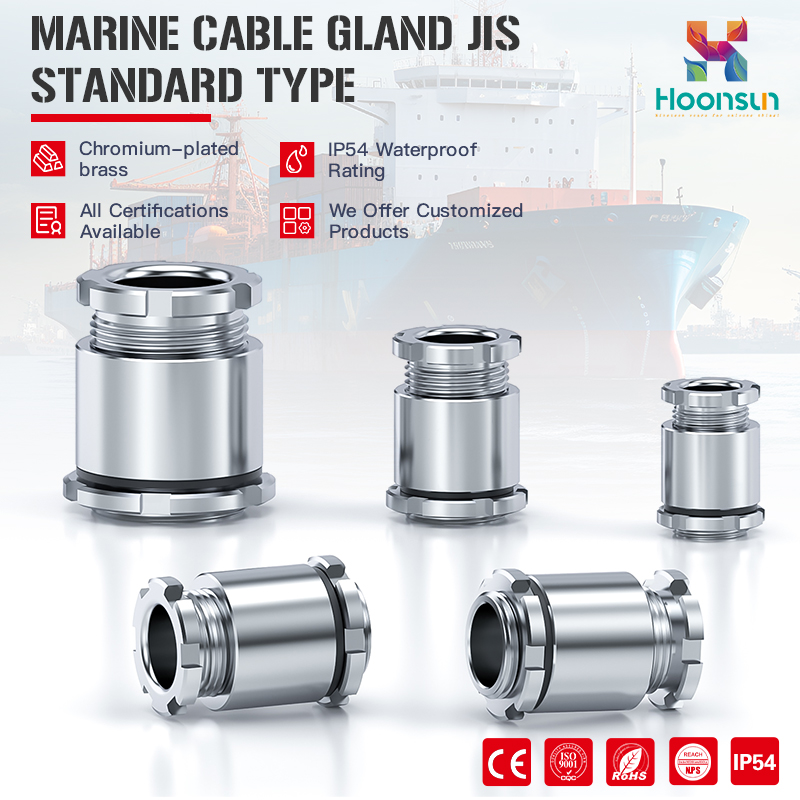
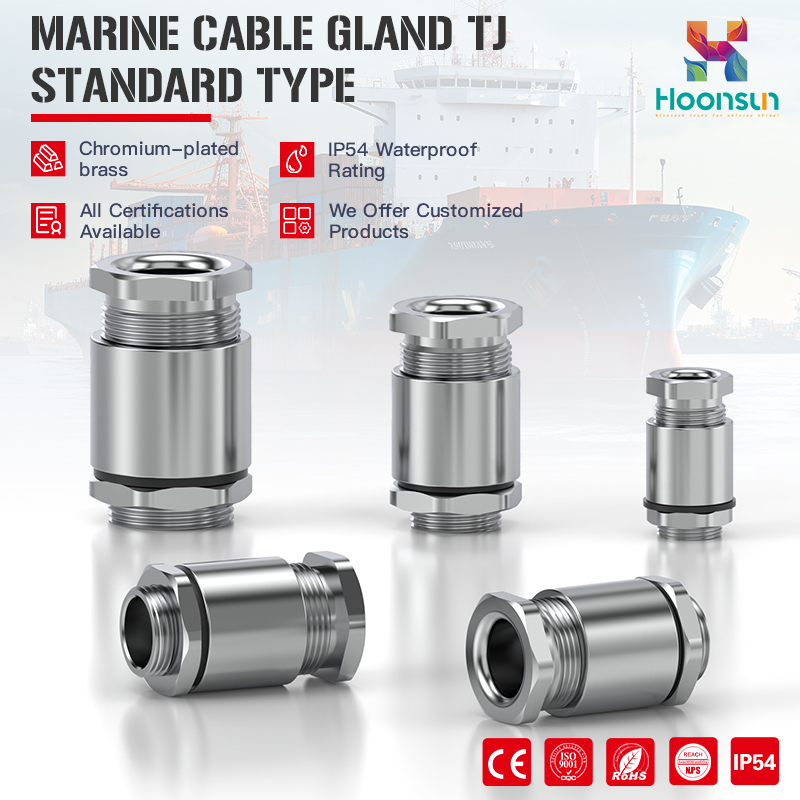
The marine environment is the most aggressive corrosion environment on earth. Salt spray, constant humidity, UV radiation, mechanical vibration, and thermal cycling combine to destroy substandard electrical fittings within months. For procurement engineers specifying cable management for ships, offshore platforms, and port infrastructure, choosing the right marine cable gland is a safety-critical decision governed by international classification societies and flag-state regulations.
This guide is written for naval architects, ship electrical engineers, EPC contractors, and technical buyers who need to match the right marine gland to the right application — from below-decks switchgear rooms to topside exposed cable runs in aggressive saltwater environments. Zhejiang Hongxiang Connector Co., Ltd. (Hoonsun) has supplied marine cable glands since 2006, with products accepted by customers holding Lloyd's Register, DNV GL, Bureau Veritas, and ABS class approvals.
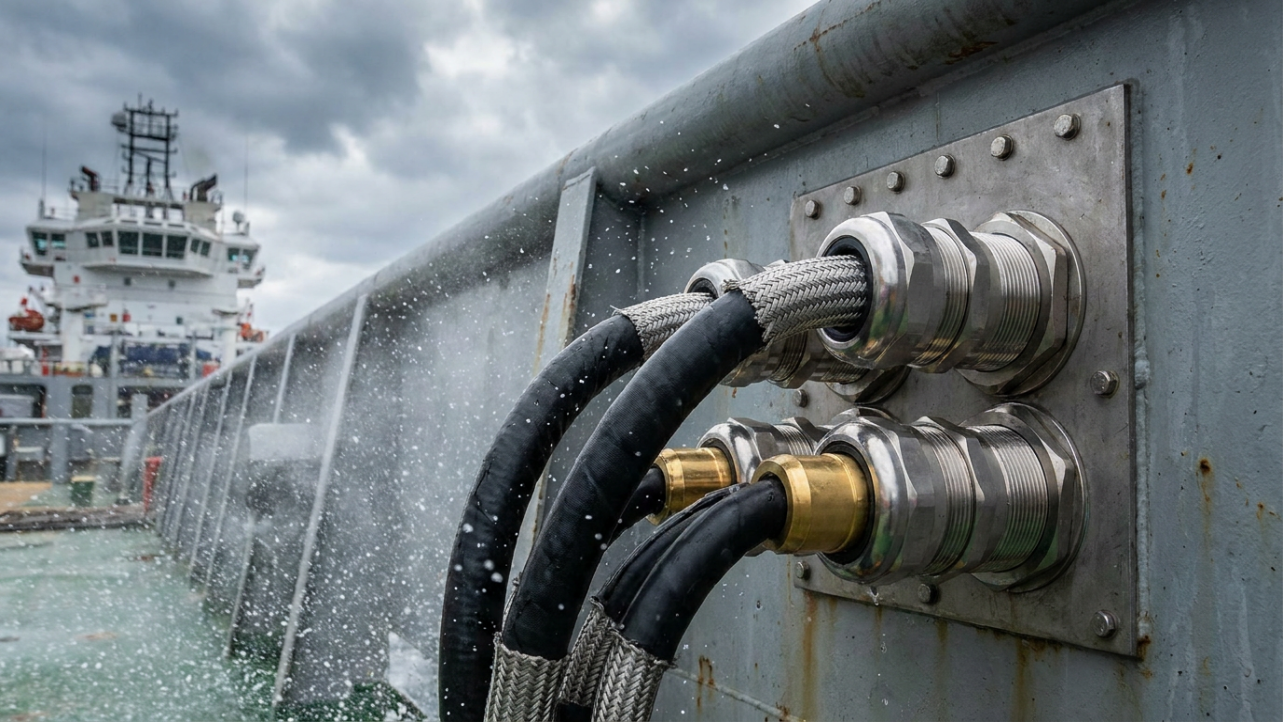
Standard industrial glands — even those rated IP68 — are not designed for the continuous salt-air exposure, high-vibration ship structures, or flame-retardancy requirements of IMO regulations. Marine cable glands must satisfy several additional requirements:
This standard governs cable penetration fittings in ship wiring systems. It specifies minimum IP rating, sealing material compatibility, and temperature performance required for shipboard cable gland installations. Glands must maintain their IP rating under thermal cycling from −40°C to +85°C.
The International Association of Classification Societies Unified Requirements E10 defines performance standards for electrical equipment on ships, ensuring cross-acceptance between major classification societies. Compliance simplifies procurement and approval processes for global ship operators.
|
Installation Zone |
Recommended Material |
Min. IP Rating |
Key Reference |
|
Below-decks switchgear room |
DZR Brass |
IP66 |
IEC 60092-303 |
|
Topside exposed cable run |
316L Stainless Steel |
IP68 |
IEC 60092-303 / IACS UR E10 |
|
Engine room (high vibration) |
DZR Brass + Lock-nut |
IP66 |
IMO FTP Code |
|
Offshore platform (Zone 2 Ex) |
316L SS + Ex e rating |
IP66/IP68 |
IEC 60079-14 |
|
Underwater hull penetration |
316L Stainless Steel |
IP68 |
Class Society Approval |
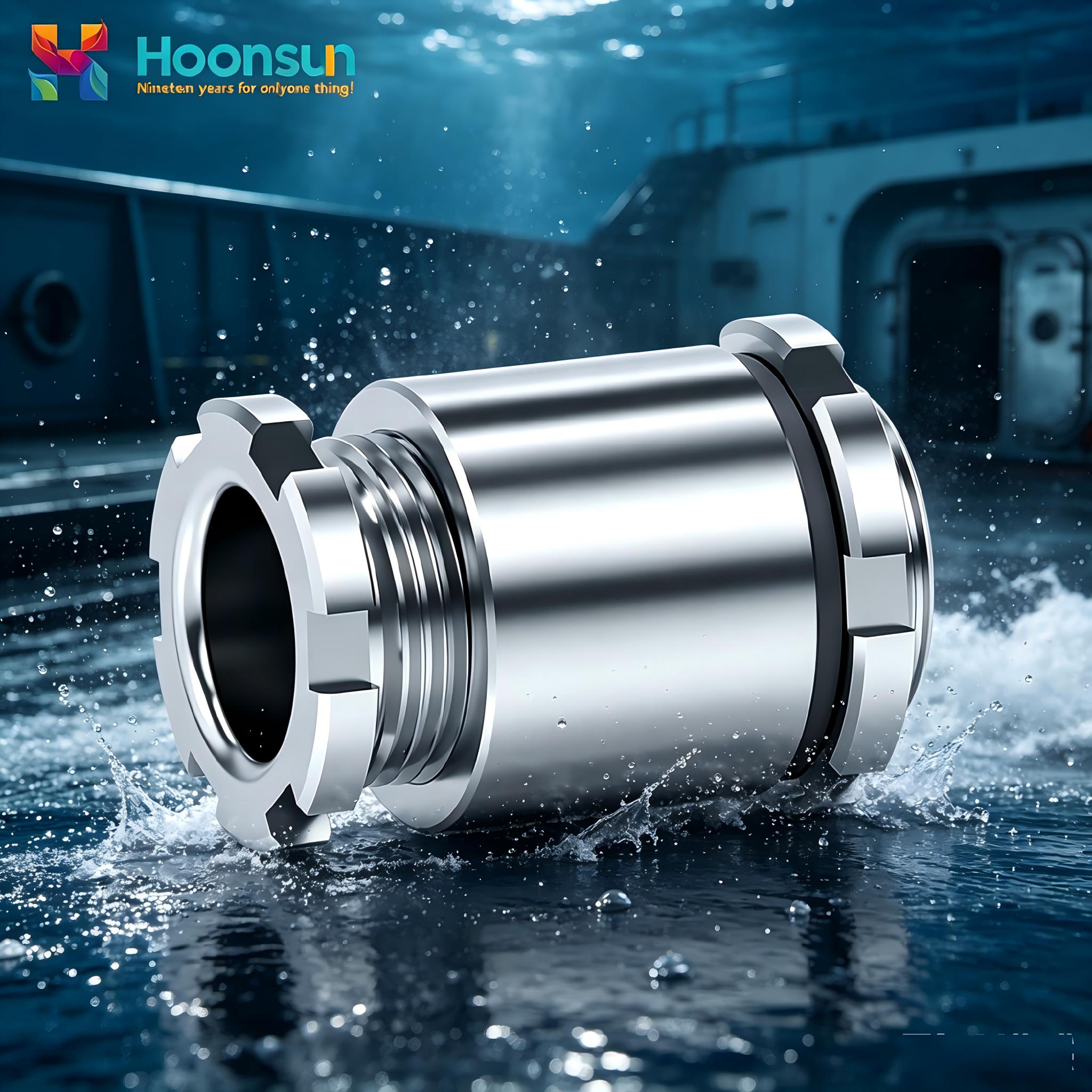
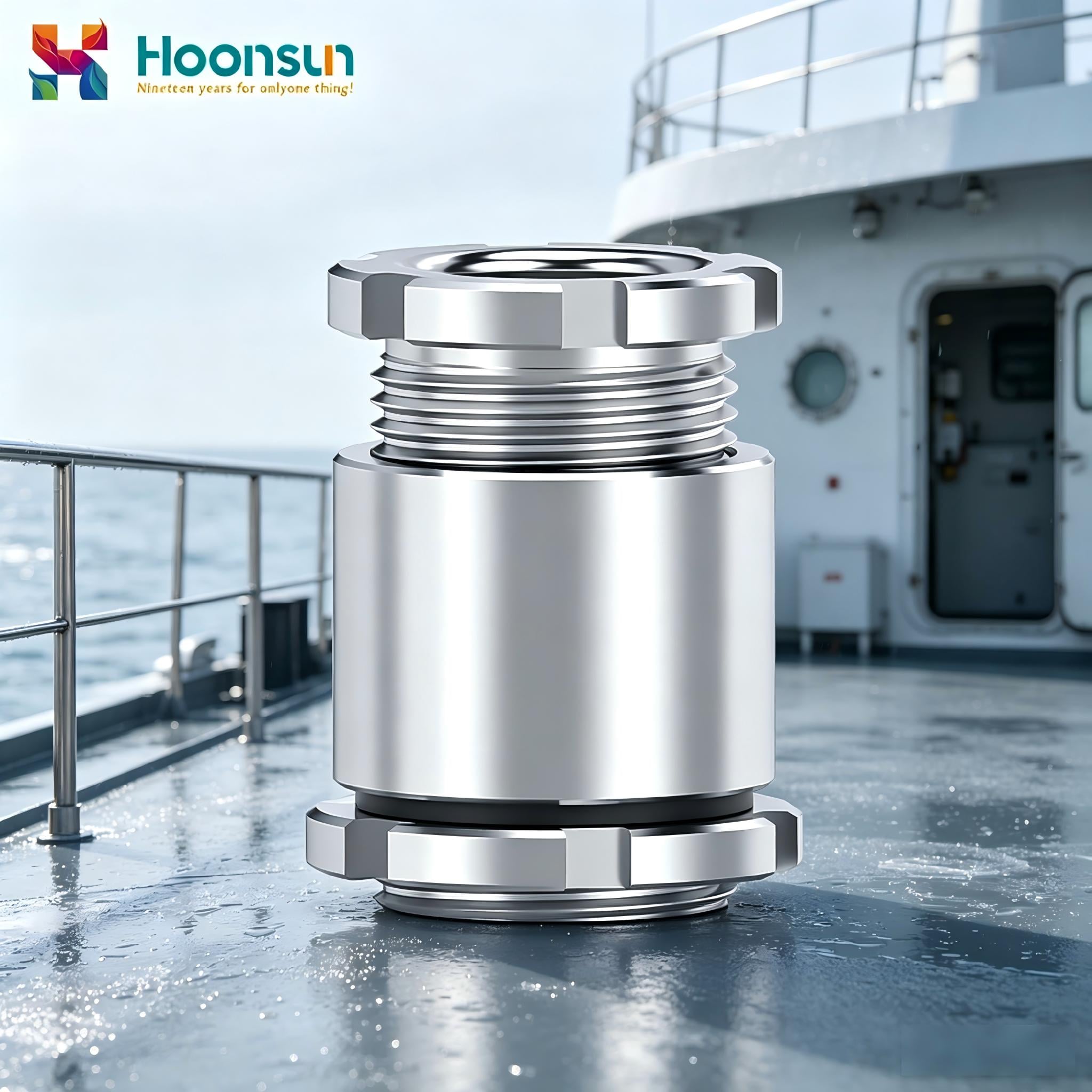
Founded in 2006 in Yueqing, Wenzhou — China's electrical component manufacturing heartland — Hoonsun operates a 10,000m² ISO 9001-certified facility with automated CNC machining and dedicated quality inspection lines. Our marine product line covers DZR brass and 316L stainless glands in M-thread and NPT, with cable OD coverage from 3mm to 60mm. Annual output exceeds 80 million pieces across nine product lines, supporting call-off scheduling for large shipbuilding projects. OEM/ODM service available with custom threads, private-label packaging, and tooling in 35–45 days.
Q1: Why is standard plain brass not suitable for long-term marine cable gland installations?
A1: Standard brass suffers rapid dezincification and corrosion in seawater chloride environments, which degrades thread integrity, breaks sealing performance and weakens armor clamping force within months of salt-spray exposure. Marine-grade cable glands use dezincification-resistant (DZR) brass for general above-deck and coastal use, or 316L stainless steel for fully immersed, highly corrosive offshore applications to maintain long-term structural and sealing stability.
Q2: Why do shipbuilding and offshore projects require classification society approvals for cable glands?
A2: Classification society approvals (including Lloyd’s Register, DNV GL, Bureau Veritas, ABS and CCS) verify that cable glands meet unified marine safety, fire-resistance and durability standards. Compliance with IACS UR E10 also ensures cross-acceptance between major classification societies, which simplifies global procurement, vessel flag-state registration and periodic inspection workflows for ship operators and EPC contractors.
Q3: What IP rating is required for topside exposed marine cable runs?
A3: For topside exposed cable runs in wave-splash zones, a minimum IP68 rating is mandatory per IEC 60092-303, to withstand continuous seawater splash, salt spray and temporary immersion. Below-decks switchgear rooms can use IP66-rated DZR brass glands, while underwater hull penetrations require IP68-certified 316L stainless steel cable glands with full classification society approval.
 Hot News
2026-10-22
2026-10-22
2026-10-13
2026-10-10
2026-09-30
2026-09-24

Copyright © Zhejiang Hongxiang Connector Co., Ltd. All Rights Reserved - Privacy Policy
 EN
EN